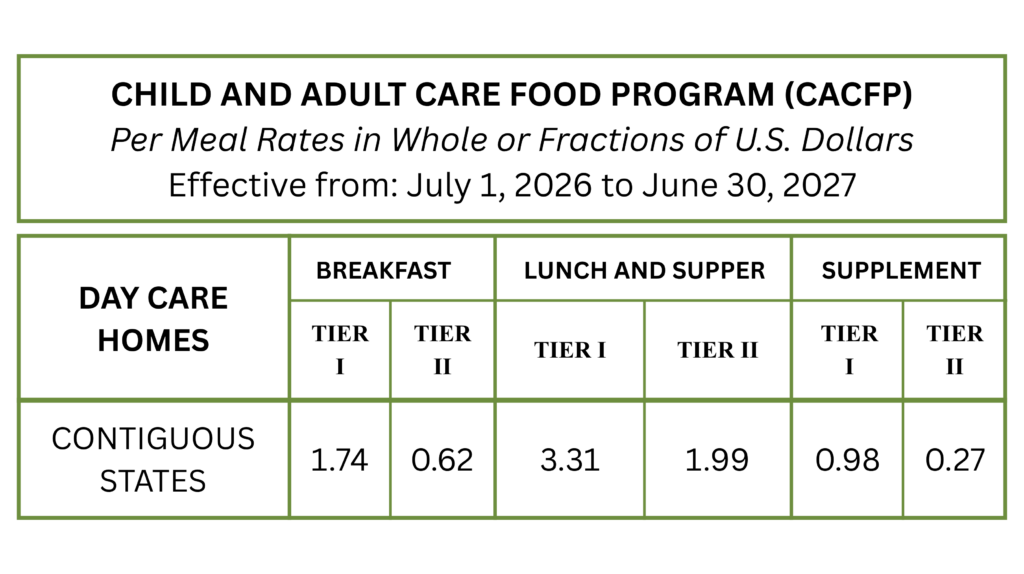
In July 2026, the U.S. Department of Agriculture published the required, annual reimbursement updates for the Child and Adult Care Food Program (CACFP) using the Consumer Price Index, as mandated by Congress. These annual adjustments, required in the federal child nutrition law, are built on insufficient rates overall and a faulty formula that does not recognize the labor and effort of home-based child care providers who participate in the program. While the tiny increases are welcomed, we know this is not enough to meet the needs of growing children or to compensate hard-working child care providers.
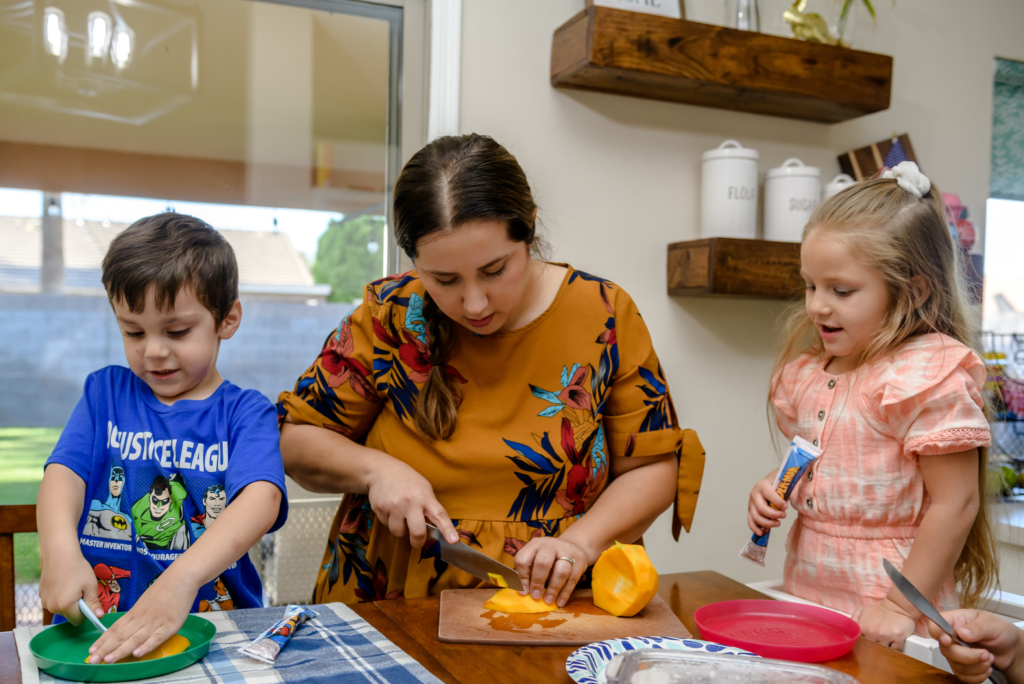
For providers to be reimbursed through CACFP and to ensure children get what they need to grow, play, and learn, providers need to offer substantial meals that meet nutritional guidelines. Good nutrition means whole grains, dairy, fruit, vegetables, and protein. Child care providers devote time to menu planning, shopping, preparation, cooking, and serving meals and snacks. The CACFP reimbursement rate should reflect the cost of these nutritious foods and the time and effort the provider spends preparing these meals and snacks.
The New Rates
The CACFP reimbursement rates for child care centers and home-based child care for this program year (July 2026–June 2027) amount to a 2.74% increase for home-based child care providers participating in CACFP.
This means 4 more cents for a child’s breakfast, 9 more cents for lunch, and 2 more cents for a snack, if it is a Tier I home. For a Tier I home-based provider serving seven children two meals and a snack, this could mean a monthly increase of only $22.73. For a Tier II home, it could mean closer to $12 per month.
Invisible Labor
Congress requires the USDA to calculate the annual rate adjustments for inflation using CPI’s Food Away From Home; rate for centers and the Food At Home rate for home-based child care providers. These are not the same: Food Away From Home, based on restaurant and other foodservice purchases, includes some modest count of the foodservice labor of workers.
Food At Home, based on grocery store or supermarket purchases, is calculated thinking about food prices alone, and does not consider compensating the labor of the person who is shopping, preparing, and serving meals and snacks. Years ago, some members of Congress decided that these caregivers can provide invisible labor since they operate in their own home. This is an outdated way of understanding child care.
Significant Shortfalls
The Home Grown Policy Work Group and Insight Panel shared their experiences with groceries, meals, and snacks in 2026 compared to 2025 in a June 2026 survey. The survey revealed that providers experienced significant financial shortfalls.
CACFP reimbursements were not covering the full cost of food for any of the survey respondents. Last year, providers reported that CACFP covered 50–75% of food costs, and now the majority (63.2%) of providers report it covers just 25% or less.
These newly released rates arrive against an alarming backdrop where providers have already been forced to make changes to their menus and spend uncompensated hours chasing sales at discount chains.
“Asking parents to send food doesn’t always suffice; the children always want to eat something extra beyond what is sent.” – FFN caregiver, Texas
“I cannot provide afternoon snack, and soon I will remove dinner from my program plans.” – Family Child Care Provider, New York
Because of significant long-term gaps, most providers surveyed (94%) are left with zero reimbursement to cover the labor of meal planning and preparation. Ultimately, the soaring cost of providing healthy meals for the children in their care continues to drive providers into financial distress, forcing many to take on credit card debt, cut their own salaries, or rely on food banks and safety net programs to feed their own families.
More Than a Business Challenge
For home-based child care providers, the gap between the high cost of food and the meager increases in USDA reimbursement rates is not just a frustrating business challenge. That shortfall is being bridged directly by the providers themselves, and in some cases they are sacrificing their own financial security. The Home Grown survey found 1 in 3 are borrowing money or adding to credit card debt to cover the cost of food for their family.
Child care providers not only need to feed their own families but also must stretch CACFP reimbursements to feed the children in their care. They are doubly impacted by the pressures of rising food prices.
- The RAPID Survey Project reported a significant percentage of child care providers struggle to have enough food. They found increasing economic hardship faced by child care providers, which has been exacerbated by rising costs and insufficient support.
- A recent Urban Institute report describes American workers’ precarious financial arrangements just to put food on the table.
“I had to decrease healthy eating habits for my family and less fresh food items.” – Family Child Care Provider, Nebraska
“Bulk purchasing is out of reach as I don’t have time to travel that distance — besides the price of gas. I purchase foods at Walmart and our local supermarket. I have not made any changes to what I serve, but I have had to take less in salary.” – Family Child Care Provider, Maine
The Solution Is in the Hands of Members of Congress
The shortfall created by inadequate CACFP payment rate policies means hardship for child care providers, reduced access to healthy food for young children, and strains on family budgets. Providers take their caregiving responsibility seriously, however this program is not set up to help them succeed. We need CACFP to reimburse providers for the full cost of food and their labor and effort. To do this, we need to increase the base rate for reimbursements, transition to using the food away from home CPI for annual adjustments, and reimburse providers for all healthy meals and snacks served during the workday.
Members of Congress can take an important first step by supporting The Early Childhood Nutrition Improvement Act (H.R. 2818 and S. 1447) and The Child Care Nutrition Enhancement Act (H.R. 2859 and S. 1420).