It’s been a long, hard winter for caregivers. Cuts to medicaid, steep increases in health insurance premiums, and deportations of immigrants who make up more than 20% of the care workforce have made it even harder for child care providers to keep their doors open when wages are low and stress is high.
According to the Center for Law and Social Policy (CLASP), “Child care workers are disproportionately people of color, including Black workers at 15.6% compared to 12.1% of the overall workforce and Hispanic workers at 23.6% in this sector, compared to 17.5% of the overall workforce.” Those statistics have deep roots in a history of oppression. In the time of slavery, enslaved black women took care of white children while not being allowed to take care of their own. Post emancipation, domestic work was one of the few options available to Black women. In more recent history, immigrant women often took on caregiving jobs as an entry point into employment, and then stayed to build successful, licensed programs in their own homes or communities. Now, nearly half a million early childhood educators are immigrants. This includes caregivers from countries like Somalia, Cuba, and Venezuela, whose Temporary Protected Status under U.S. immigration law has recently been terminated, so that they no longer have legal work authorization in the United States.
This month, to honor the labor, wisdom, and courage of Black caregivers, we spoke with Wanda Chandler-Tillman and Octavia Mclaurin, home-based providers in Charlotte, North Carolina and Las Vegas, Nevada, who are standing strong for children, families, and child care providers in the face of unprecedented challenges.
Leading the Way for Home-Based Providers
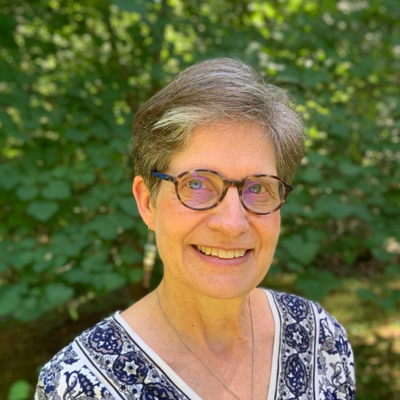
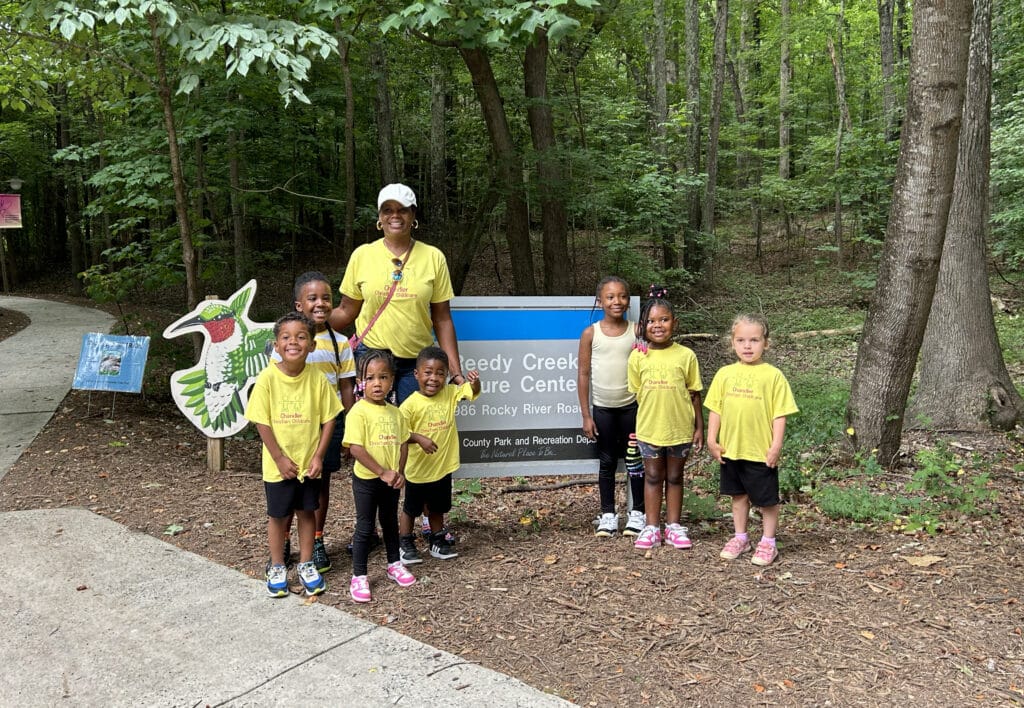
Wanda Chandler-Tillman has operated her family child care home in North Carolina for almost 28 years–starting in 1997, when, as a young single mom, she was still living with her parents. Eventually, she got married, moved into her own home, and when her daughter graduated high school, Wanda decided it was time to return to college for her associates degree. Learning while still running her childcare business and advocating for home-based childcare has kept her very busy for the past decade. She got the associates degree, then a bachelor’s degree in sociology, a master’s degree in Birth through Kindergarten Interdisciplinary Studies, and is now a doctoral candidate in Educational Leadership at UNC-Chapel Hill!
Families seek out Wanda’s home-based program not just for her academic accolades and work as a consultant and trainer in early childhood education, but also for her great reputation throughout the neighborhood as a care provider. These working families depend on consistent and reliable child care in order to work. Wanda knows she charges less for her services than do many other child care providers, even though her costs, including health insurance premiums through the Affordable Care Act marketplace, have increased substantially this year. “I know that even with a good job and education, child care is expensive, so I try to be fair and also meet the needs of my own household,” she says.
Health insurance is just one of the issues she has raised with the University City Child Care Network (until last month, she was chair of the network), where she works to empower and embolden other child care providers to speak up about policies that make it harder for providers to keep their businesses open and thriving. “State and federal officials need to know that we’re capable, we’re competent, we’re resilient, we’re entrepreneurs. But a lot of us don’t even have health insurance. And we’re worried about recent actions like the freezing of federal funds for child care programs” that resulted from baseless fraud charges against Somali-run programs in Minnesota.
Then, in North Carolina, home-based providers’ reimbursements from the Federal Food Program (CACP), were delayed as a result of the fall 2025 government shut down. “We didn’t get reimbursed for two months, until almost the end of December, and that only affected home-based programs, not centers, so it felt like we were unfairly targeted. That was hard, and we have to feed our children just like centers do, so we need to get fired up about things like that and speak up for ourselves.”
Standing Up for the Rights of Kids with Disabilities
Across the country in Las Vegas, Nevada, Octavia Mclaurin is also standing up for the rights of children and families.
Octavia has 13 children of her own, and has been a licensed early childcare educator operating both centers and a home-based childcare program since 2008. She now lives in Las Vegas, Nevada, where she cares for eight children in her 4-star group home, including one with autism and others with learning disabilities. One of Mclaurin’s superpowers is advocating for families of children with special needs.
One of Octavia’s own children has paraplegia as a result of an accident. Octavia supported him through learning to live with a disability and be successful living independently. Now she helps other parents of children with disabilities “who are dealing with 504 plans or IEPs, so when they go to a conference at the school, they understand what level of education their child should be receiving. I don’t like labeling kids, so when the school says ‘he has this behavior,’ I don’t consider them bad behaviors, I just say they’re misled or misunderstood.”
In her own program, she also teaches children to stand up for themselves and to speak in ways that invite respect and conflict resolution. For example, “If they have a problem with their mom, I teach them to say, ‘Mom, you asked me not to do something, and I’m asking you to explain it to me.’ I do a lot of redirecting, a lot of explaining, a lot of showing, but kids are intelligent and if they can learn to express their feelings and thoughts in words, they can learn how to act respectfully.”
Octavia opens her doors to families of all backgrounds, and knows that what appeals most to families is that they feel comfortable knowing their child is in a safe place, a place where they feel like they are home, and there’s always respect for who that child is, as well as high expectations for them to respect others. “I tell the kids, we have to speak up for ourselves, because if we don’t advocate, then our voices won’t get heard, and everyone deserves to be seen and valued.”
In 2026, when the phrase “diversity, equity, and inclusion” has taken on negative connotations, that’s an important message for all children, families, and child care providers. At Home Grown, and in home-based child care programs, DEI is still a principle to live by: everyone deserves to be fully included and treated fairly, regardless of race or background. By listening to and learning from leaders like Octavia and Wanda, we continue to center community wisdom and move this work forward with purpose and care.